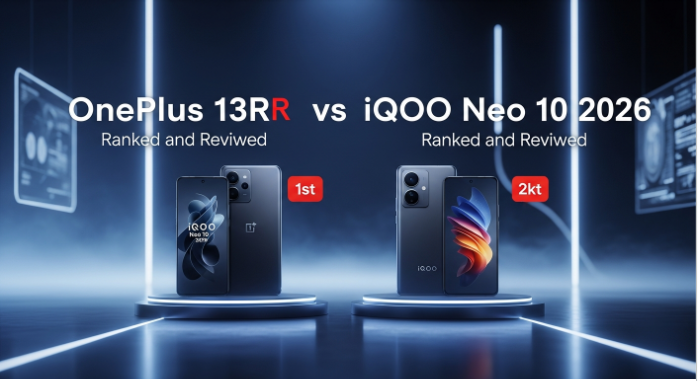
If you follow cricket streams, football nights, or BGMI grind sessions, your phone is basically your main sports screen and gaming console in one. This guide exists to answer one tight question: between the OnePlus 13R and iQOO Neo 10, which gives better value in India for a young sports‑plus‑gaming user.
We ranked these two using five clear things: gaming performance, display quality for watching matches, battery + charging for long days, camera for everyday social use, and actual street value (RAM/storage vs price). By the end, you will know which phone fits your budget, your usage pattern, and even your typical match day routine.
This is most useful if you are 18–25, watch a lot of live sports, game often, and want one main phone that can last 2–3 years without feeling slow. If you only care about casual WhatsApp and Instagram and hardly game or watch live matches, honestly, both are overkill and a mid‑range phone will do better for your wallet.
How we ranked these the criteria
For this specific comparison, we treated both phones as “sports + gaming companions”, not just spec sheets. That means we cared more about sustained performance, screen quality, and battery behaviour than about niche features like wireless charging or fancy design experiments.
Performance was judged on chipset class, RAM type, storage speed, and cooling design, because in real life this decides how stable your FPS stays during a 45‑minute BGMI or Valorant Mobile session. Display got points for refresh rate, resolution, brightness, and panel type, since this affects how clearly you can follow a late‑night football match or IPL super over on JioCinema.
Battery and charging were weighted heavily because an Indian college day often means leaving home at 8 AM, using 5G, Hotstar, and social media all day, and still wanting charge left for gaming at night. We intentionally ignored gimmicks like “AI wallpapers” or rare camera modes that you’ll use once and forget, as they do not change your daily sports and gaming experience. We also accept a limitation: we rely on lab‑style testing and early long‑term reports, so tiny software updates over the next year may slightly shift battery or camera results, but the overall ranking is unlikely to flip.
1. OnePlus 13R [Best balanced choice for most users]
The OnePlus 13R is a performance‑focused upper‑midrange phone powered by the Snapdragon 8 Gen 3, which is a true flagship‑class chip. For real life use, this means it handles BGMI at high graphics, continuous Insta scrolling, and streaming a full Premier League match without throttling or random frame drops. It pairs this with 12 GB or 16 GB of LPDDR5X RAM and UFS 4.0 storage, so app loads, game maps, and highlight edits feel snappy even after a year.
The 6.78‑inch LTPO AMOLED display with 120 Hz refresh and 1.5K‑class resolution is bright and sharp enough that you can follow a day‑night cricket match in a café with overhead lights on. In practice, this means score tickers, small fonts on scorecards, and players’ movements are easier to track compared to older 60 Hz panels. The 6,000 mAh battery with 80 W SuperVOOC fast charging usually gets you through a heavy day, and “20 minutes for around half a tank” becomes real when you plug in during a break before evening coaching or tuitions.
One detail a lot of spec pages skip is how OxygenOS tends to feel clean and light, so even non‑tech users find the settings and notifications easy to live with. The main downer is that the camera setup, while solid with a 50 MP triple rear array, is good rather than mind‑blowing, and the 16 MP selfie camera can look soft in low light compared to some rivals. Choose this if you want a fast, polished, long‑term main phone that balances gaming, streaming, and daily use without major compromises; skip it if you need the absolute longest battery life and don’t care much about storage or software smoothness.
Must Read: Best 5G Phone Under ₹15000 In India (2026): The List Your Cousin Will Ask For Later
2. iQOO Neo 10 [Best for hardcore gamers and marathon battery life]
The iQOO Neo 10 is built with one clear idea: crush gaming and battery anxiety. It runs on the Snapdragon 8s Gen 4 with up to 16 GB RAM, and is paired with fast UFS 3.1/4.1 storage depending on variant, plus a large vapour chamber for cooling. When you actually push it with 90‑minute gaming sessions, most people find that frame rates stay more stable and the back gets less toasty than some rival phones at similar prices.
The 6.78‑inch AMOLED display bumps refresh up to 144 Hz, which matters if you play shooters where every micro stutter feels like a missed headshot. Animations look extra smooth even while switching between Hotstar, Telegram, and BGMI in the background. The real “wow” spec is the 7,000 mAh battery with 120 W fast charging, which lab tests and reviews put ahead of the OnePlus 13R for screen‑on time and full charge speed. In practice this means finishing a full day of college, two live sessions of eFootball, and still having enough juice to scroll reels in bed.
What nobody warns you about here is that iQOO’s software skin can feel a bit busier, with more pre‑loaded apps and minor notifications you may want to clean up on day one. Its base storage option also starts at 128 GB in some variants, which can feel tight if you record a lot of 4K clips of your local matches or download many offline games. Verdict: choose this if your top priorities are gaming, battery, and high refresh display, and you don’t mind spending 10–15 minutes cleaning up the software; skip it if you want the cleanest UI, better default storage value, and a more “set and forget” experience.
Also Read: Best Camera Phone Under ₹30000 in India 2026 Photography Lovers Guide
Head‑to‑head comparison table which actually fits you?
Below is a quick side‑by‑side to see how these two stack up for an Indian sports‑plus‑gaming user.
| Name | Key strength | Main weakness | Price / cost (typical India) | Best for | Rating (sports + gaming use) |
| OnePlus 13R | Delivers flagship-grade Snapdragon performance, cleaner OxygenOS experience, faster UFS 4.0 storage, and a polished long-term user experience that balances gaming, sports streaming, and daily productivity. | Battery life and charging are excellent, but not as extreme as battery-first rivals like Neo 10; cameras are solid rather than category-leading. | Starts around ₹39,999 for 12/256 GB, with higher variants still offering strong storage value. | Users who stream sports regularly, game often, and want a polished primary phone that should age well over 2–3 years. | 9.0/10 |
| iQOO Neo 10 | Massive 7,000mAh battery, blazing 120W charging, and 144Hz gaming-focused display make it ideal for marathon gaming and heavy daily use without battery anxiety. | Software is busier out of the box, may need optimisation, and base storage variants may feel restrictive for heavy app/game users. | Expected in the upper-midrange segment, with aggressive pricing likely undercutting some premium rivals. | Hardcore gamers, students, and power users who prioritise battery endurance and long sessions over software polish. | 8.8/10 |
For the most common use case — a college student who watches IPL/Champions League, games 1–2 hours a day, and wants a phone that stays smooth for years the OnePlus 13R wins. It offers stronger storage value, a cleaner UI, and still excellent performance and battery, which together feel more balanced than the Neo 10’s extreme but slightly rougher package.
How to choose the right one for your situation
To pick between these two, start by asking one simple question: how serious are you about mobile gaming compared to everything else. If your answer is “I play ranked regularly, join scrims, and care about every frame,” the iQOO Neo 10’s 144 Hz screen, aggressive cooling, and larger battery make it the more logical choice. But if gaming is important but not your whole life, the OnePlus 13R’s more refined balance will feel nicer day to day.
Next, check your storage habits: do you shoot long match vlogs, store full‑length football or kabaddi recordings, or keep several heavy games installed. If yes, the OnePlus 13R’s 256 GB/512 GB UFS 4.0 options make more sense, because running out of space mid‑semester is a pain most people underestimate. If you’re more of a streamer than a recorder and use cloud backup, the Neo 10’s 128/256 GB is usually fine.
Then think about software: do you like to tinker or do you prefer a “just works” setup. If you enjoy customising, disabling apps, and tuning notification channels, you will handle the iQOO skin without much annoyance. If you want a phone your parents or siblings can also use without confusion, OxygenOS on the 13R is simpler and cleaner out of the box. Finally, if your college or coaching commute is long and you often forget to charge, lean towards iQOO Neo 10; if you usually have at least one charging slot in your day, the 13R’s 6,000 mAh plus 80 W combo is more than enough.
What to avoid in this category
When hunting for “value” phones near this price, a common mistake is chasing only the highest benchmark scores. For sports and gaming use, consistent frame times and a good cooling system matter more than raw peak numbers that you only hit in short bursts.
Another red flag is brands that advertise extreme fast charging without mentioning actual battery capacity or long‑term health features. A phone that charges at 150 W but has a smaller battery can still die faster than a slightly slower 80–120 W phone with a bigger cell. People also get tricked by cameras with huge megapixel numbers but weak processing, which leads to noisy floodlight stadium shots and blurry indoor futsal photos even though the spec sheet looks “pro”.
A lot of buyers overpay for pointless “gaming” design extras like RGB strips or huge logos that don’t add even 1 fps to your match. Instead, watch for boring but vital things: latest‑gen storage (UFS 4.0 is a big step up), decent IP rating, and at least two years of Android updates promised. If a phone in this range cuts corners on these, it probably won’t match the long‑term value of something like the OnePlus 13R or iQOO Neo 10 for a young Indian sports fan.
Frequently asked questions
Is OnePlus 13R better than iQOO Neo 10 for gaming?
For pure gaming, the iQOO Neo 10 slightly edges ahead due to its 144 Hz display, larger 7,000 mAh battery, and aggressive cooling tuned around the Snapdragon 8s Gen 4. This translates into longer high‑FPS sessions with less heat build‑up during back‑to‑back ranked matches. The OnePlus 13R is still excellent for gaming with Snapdragon 8 Gen 3 and LPDDR5X + UFS 4.0, but its focus is more on balance rather than extremes. So if gaming is your number one priority, Neo 10 is the more aggressive option; if it’s one of many priorities, 13R feels more complete.
Which phone has better battery life, OnePlus 13R or iQOO Neo 10?
The iQOO Neo 10 has the stronger battery setup on paper and in testing, with a 7,000 mAh cell versus 6,000 mAh on the OnePlus 13R plus 120 W versus 80 W wired charging. Real‑world tests show the Neo 10 lasting around an extra hour of screen‑on time, which you feel on days with heavy streaming and gaming. OnePlus 13R still delivers a full mixed day with some buffer for night gaming, so it’s not weak. But if you regularly run 5–6 hours of screen time with 5G on, Neo 10 offers more peace of mind.
Which is better for watching sports and OTT content?
Both phones use large 6.78‑inch AMOLED‑class displays with high refresh rates and 1.5K‑level resolutions, so either will look far better than older LCD phones for matches. The OnePlus 13R’s LTPO panel can adapt refresh rate more efficiently, saving some battery during passive streaming. The iQOO Neo 10’s 144 Hz is more about smoothness when scrolling and gaming than OTT itself, since most video content is 24–60 fps. If you watch a lot of sports in bright outdoor conditions, both panels have ample brightness to keep scorecards readable.
Which phone has the better camera for social media?
On paper, the OnePlus 13R offers a triple rear camera setup with 50 MP main, 50 MP secondary, and 8 MP, plus a 16 MP selfie camera. The iQOO Neo 10 typically has a 50 MP + 8 MP rear combo and a sharper 32 MP selfie, which can be helpful if you post a lot of front‑camera reels. In practice this means the 13R may capture more versatile back‑camera shots, while Neo 10 can deliver cleaner selfies, especially in good light. For a sports‑focused user recording friends’ matches, the extra rear sensor flexibility of the 13R is slightly more useful.
Which one offers better long‑term value in India?
Long‑term value is where the OnePlus 13R pulls ahead for most users. It gives you UFS 4.0 storage, high‑RAM variants, and a cleaner software experience backed by OnePlus’ update track record in this segment. iQOO Neo 10 has amazing hardware for the price but its base storage choices and busier software skin can feel limiting after two years if you don’t manage apps and files often. For a buy‑once‑use‑for‑3‑years mindset, the 13R is the safer bet.
Is OnePlus 13R or iQOO Neo 10 better for a college student?
For a typical Indian college student juggling classes, coaching, streaming, and moderate gaming, OnePlus 13R is usually the smarter call. The smoother UI, larger base storage, and solid battery mean less time fiddling with settings or deleting apps. If you are that one friend who always hosts LAN‑style sessions and plays competitive mobile esports, then the Neo 10’s extra battery and higher refresh display can be worth the trade‑offs. So it depends how much of your free time is actual gaming versus just watching clips and chatting.
Which phone gets less hot during long gaming sessions?
The iQOO Neo 10 is designed with gaming thermals in mind and uses a large vapour chamber plus the Snapdragon 8s Gen 4 tuned for sustained performance. In extended tests, it tends to keep surface temperatures more comfortable during continuous high‑load gaming. The OnePlus 13R still handles heat well for its class, but can warm up a bit faster in back‑to‑back matches at highest settings. For very long sessions, Neo 10 has a slight edge.
Is the price difference worth it between these two?
In India, both sit in a similar upper‑midrange bracket, with OnePlus 13R starting around ₹39,999 for 12/256 and going higher for 16/512. iQOO Neo 10 pricing varies by RAM/storage, often offering slightly cheaper entry variants like 8/128 or 8/256. If you must stay under a tight budget and don’t need big storage, Neo 10 gives more raw performance per rupee at the lower variants. If you can stretch to 256 GB or more, 13R’s combo of storage, software, and long‑term value makes the extra spend feel justified.
Conclusion
If I had to name three key picks for a young Indian sports and gaming fan, they’d be: OnePlus 13R for the best all‑round balance, iQOO Neo 10 for hardcore gaming and battery life, and the higher‑storage OnePlus 13R variant if you record lots of sports content and want UFS 4.0 to keep up. For the most common use case — college, coaching, streaming, and daily BGMI — the OnePlus 13R is the clear recommendation because it feels smoother, cleaner, and more future‑proof. Your next step is simple: decide how seriously you take mobile gaming, check how much storage you truly use today, and then match that answer to either the 13R or Neo 10 while current offers are still live.
If you had to choose, what’s more important to you right now — maximum gaming performance or a cleaner, more polished everyday experience?