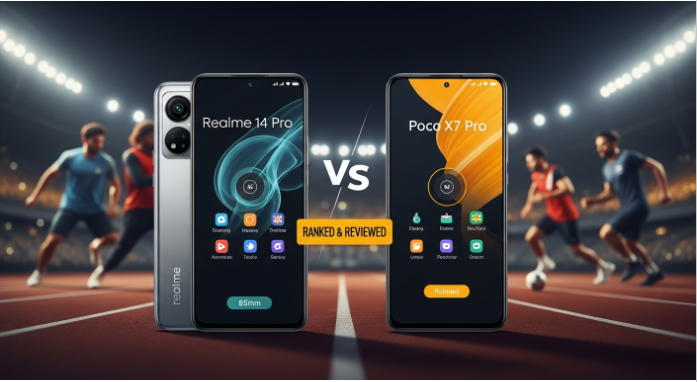
If you watch live football at 1:30 AM, spam IPL highlights, and grind BGMI or Valorant Mobile, the wrong phone will ruin both your K/D and your battery. This guide exists for one narrow question: between Realme 14 Pro and Poco X7 Pro, which is actually better for Indian sports-obsessed users on a mid-range budget in 2026.
We ranked them on four hard checks: sustained gaming performance, display quality for sports, battery + charging for late-night streaming, and camera for stadium and turf shots. By the end, you will know exactly which one fits your exact use case, not just which one “looks good on paper.”
This guide is perfect if you are 18–25, spend too much time on Hotstar, JioCinema or YouTube, and care more about fps and screen brightness than “brand image.” It is not for people who only use WhatsApp and Instagram and just want the cheapest thing possible.
How We Ranked These The Criteria
For this match-up, we ignored the usual “overall best” and focused on how these phones behave when your day revolves around sports and gaming. That means long streaming sessions, 90-minute football matches, double-header cricket days, and rank-push gaming nights.
First, performance: the Dimensity 8400 Ultra inside the Poco X7 Pro is built on a 4 nm process and clocks higher than the Dimensity 7300 Energy in the Realme 14 Pro, which matters when games start to heat up and throttle. We looked at real-world reports and typical benchmarks where 8400 Ultra pulls clearly ahead in GPU-heavy loads like high graphics BGMI and Asphalt.
Second, display and brightness: sports fans often watch under tube lights, in hostels, or outdoors on grounds. Both offer AMOLED displays, but Poco’s 6.67‑inch 1220p panel gives sharper visuals, while Realme’s slightly larger 6.77‑inch screen offers more immersion with a curved design.
Third, battery and charging: here the Poco X7 Pro’s 6550 mAh cell with faster charging options has an edge over Realme’s 6000 mAh pack for back-to-back live matches plus gaming. We deliberately ignored brands, offline offers, and camera “filters,” because those do not help you survive a Super Over during a power cut. One limitation: prices can shift with sales, so treat mentioned prices as typical, not final.
Realme 14 Pro Vs POCO X7 Pro
1. Realme 14 Pro [Best for casual gamers who want style + battery balance]
Realme 14 Pro is a slim 5G phone with a 6.77‑inch 120 Hz AMOLED display, Dimensity 7300 Energy chip, and a 6000 mAh battery, aimed at users who split time between light gaming, social apps, and endless highlight reels. It feels lighter and more stylish in hand than you expect for a 6000 mAh phone, which matters when you are holding it for an entire match. In practice this means you can watch a full ODI plus some reels and still end the day with battery left, without feeling like you are holding a brick.
What makes it stand out is the mix of IP66/68/69 water and dust resistance plus a curved AMOLED panel in this price band, something most rivals still skip. Most people find that curved screens feel more “premium” when doomscrolling scorecards or Twitter during live games. The 50 MP Sony IMX882 main camera with OIS is strong for day shots, so your stadium clips and turf photos look sharp, even if you are not a “camera nerd.”
One small detail many articles miss: the 3840 Hz high-frequency PWM dimming on the display actually helps when you watch dark night matches with brightness lowered; your eyes feel less strained compared to cheaper AMOLEDs. The honest limitation is raw performance: the Dimensity 7300 Energy is efficient but not a “beast,” so heavy titles at max settings may show drops during intense fights compared to Poco X7 Pro. Choose this if you care about design, curved screen, and strong battery more than peak gaming power; skip it if your main goal is competitive gaming with highest fps possible.
2. Poco X7 Pro [Best for heavy gamers and all-night sports binge watchers]
Poco X7 Pro is built around the Dimensity 8400 Ultra, a much stronger 4 nm chipset with higher clock speeds and better GPU performance, backed by up to 12 GB RAM and 256 GB storage. This makes a real difference when you push BGMI at HDR + high fps, or when you are screen recording highlight reels while chatting in Discord. When you actually try this side by side with a 7300-powered phone, animations feel snappier and frame drops are rarer in long sessions.
The 6.67‑inch 1220p AMOLED screen might be slightly smaller than Realme’s, but the higher resolution gives sharper text and better clarity for score overlays, minimaps, and tiny UI elements in sports games. Combined with a 6550 mAh battery, it is tuned for people who start with a 7 PM match, then play games until 2 AM. The 50 MP rear camera and 20 MP front camera handle daytime turf selfies and group photos well, and the default color tuning is on the punchy side, which many Poco users actually enjoy for social media.
What nobody warns you about is storage: the base Poco X7 Pro usually starts at 256 GB, which quietly solves the “no space” problem if you download many games and offline matches. The limitation is design and feel: the phone is a bit chunkier with that big battery, and Poco styling is more “gamer” than “clean,” so if you want a slim, classy look, it might feel loud. Choose this if performance, longer battery, and sharper display for gaming and streaming matter most; skip it if you prefer a sleeker curved design and only play light games.
Head-to-Head Comparison Table
Both phones sit in a similar price band, often around the 27–30k range depending on sales, so this is less about budget and more about use case. Here is a clear side-by-side for the mid-range sports and gaming scenario.
| Attribute | Realme 14 Pro 5G | Poco X7 Pro 5G |
| Typical street price | ~₹24,999–₹26,999 (8/128–8/256) | ~₹23,999–₹25,999 (8/256) |
| Chipset focus | Dimensity 7300 Energy — balanced but mid-tier for gaming | Dimensity 8400 Ultra — significantly stronger for high fps gaming |
| Display | 6.77″ curved AMOLED, 120Hz, more premium visual feel | AMOLED, high refresh, less premium body but more performance-centric |
| Battery | 6000mAh, strong all-day endurance | 6550mAh, better for extended gaming + streaming |
| Gaming / BGMI / esports | Good for casual to moderate gaming | Better for heavy gaming, sustained sessions, and future-proofing |
| Design & comfort | Slimmer, lighter, more style-focused | Chunkier but built around power |
| Camera / lifestyle balance | Better style + balanced media user appeal | More gaming-first than camera-first |
| Best for | Casual gamers, stylish daily use, mixed entertainment | Hardcore gamers, power users, long-session streamers |
Best overall for sports/gaming use: Poco X7 Pro 5G. Its Dimensity 8400 Ultra and bigger battery make it the stronger pick if your priority is fps stability, marathon sessions, and heavier titles.
Choose Realme 14 Pro if you care more about premium curved design, comfort, and balanced daily use with decent gaming. Choose Poco X7 Pro if raw gaming power, longer sessions, and better long-term performance matter more than slimmer aesthetics. (91mobiles)
Prices shift with offers, bank discounts, and offline store bargaining, but usually Poco gives more raw hardware at a similar price. For the most common use case — an 18–25-year-old who splits time between competitive gaming and endless sports streaming Poco X7 Pro is the clear winner because the stronger chipset and bigger battery impact daily experience more than a curved screen.
How to Choose the Right One for Your Situation
Start with one simple question: is gaming your main hobby or just a side activity? If you play ranked BGMI, COD Mobile, or similar titles for multiple hours daily, the Poco X7 Pro’s Dimensity 8400 Ultra and bigger battery will feel smoother, especially after 30–40 minutes when weaker chips start to throttle. If your gaming is mostly casual, Realme 14 Pro will be more than enough.
Next, ask how much you care about design and feel. If you want a phone that looks premium on a college bench — slim, curved, and more “flagship style” — Realme 14 Pro has the advantage with its curved AMOLED and slim body despite the 6000 mAh battery. If you are okay with a slightly thicker device because you live on charging anxiety, Poco’s extra capacity is worth it.
Also READ: Best Camera Phone Under ₹30000 in India 2026 Photography Lovers Guide
Think about storage and media habits too. If you download full matches, keep multiple big games, and save lots of RAW photos or 4K clips, the typical 256 GB base storage on Poco X7 Pro gives you room to breathe. If you stream everything online and mostly use social apps, Realme’s 128 GB base might be fine, especially if you do not record a lot of 4K video.
Finally, consider where you watch sports the most. For hostel rooms and indoor viewing, both phones work great, but for bright outdoor use on grounds or in stands, Poco’s sharper 1220p panel and strong brightness help small details like scores and mini maps pop. If your answer is “I just want a good all-rounder that looks and feels nice,” Realme 14 Pro is the safer bet. If your answer is “Give me max fps and max screen-on-time,” pick Poco X7 Pro without overthinking.
What to Avoid in This Category
When choosing between these and other mid-range phones for sports and gaming, do not get fooled by megapixel numbers or random AI camera buzzwords. A 108 MP sensor with weak processing will still give noisy stadium shots, while these 50 MP sensors with OIS often produce cleaner, more stable clips for reels.
Another common mistake is chasing the highest peak brightness number from marketing slides, while ignoring real-world tuning. If the phone heats up quickly or throttles the display, that peak brightness will not hold through a full match under the sun. People also end up obsessed with synthetic benchmarks rather than how the phone behaves in a two-hour gaming session with mobile data on, notifications coming in, and screen recording running.
Be careful with models that offer big batteries but pair them with slower charging and old chips. You think you are getting “5000+ mAh” value, but then overnight charging becomes a routine, and mid-match stutters kill the fun. Flexing “8 GB RAM” is another trap both these phones already clear that, and at this point, CPU and GPU architecture matter much more than raw RAM size.
The one thing people often overpay for is unnecessary storage tiers if they do not download games or offline content. If you only stream and post, 128 GB can be okay; paying a big jump for 512 GB storage you never fill makes no sense in a tight student budget. Put that extra money into a better chipset or a good pair of earphones instead.
Frequently Asked Questions
Does the Realme 14 Pro lag in BGMI compared to Poco X7 Pro?
In direct terms, yes, Poco X7 Pro handles heavy games better. The Dimensity 8400 Ultra offers higher clocks and stronger GPU performance than the Dimensity 7300 Energy in Realme 14 Pro. Most people find smoother fps and less stutter during long sessions on Poco, especially at higher graphics settings. Realme 14 Pro can still play BGMI comfortably on balanced settings, but if rank push is your priority, Poco is the safer pick.
Which is better for watching cricket and football streams?
Both phones have AMOLED panels with 120 Hz refresh, so motion and colors are solid on each. Realme’s 6.77‑inch curved display feels more immersive and “cinematic,” especially in dark rooms during night matches. Poco’s 6.67‑inch 1220p screen, on the other hand, gives slightly sharper text and overlays, which helps with scoreboards and notification text. If you care about a larger, premium-feeling screen, go Realme; if clarity and sharpness win for you, pick Poco.
Which phone has better battery life for long match days?
On paper and in practice, Poco X7 Pro has the edge with its 6550 mAh battery versus Realme’s 6000 mAh pack. Combined with a more efficient 4 nm chipset, Poco generally lasts longer when you mix streaming, gaming, and social media. Realme’s battery is still strong and can get most users through a heavy day, but when you stack late-night football on top of double-header cricket, Poco gives more margin.
Which camera is better for stadium and turf photos?
Both phones offer 50 MP main cameras with OIS, which is ideal for night stadium shots and shaky hands. Realme tends to lean slightly towards natural colors, which looks good for skin tones and jerseys under bright lights. Poco’s camera tuning is often more contrasty and punchy, which can make night turf photos and floodlit stadium scenes look more dramatic on social media. For most students, the difference is noticeable mainly in color taste, not in basic quality.
Is the curved display on Realme 14 Pro a problem for gaming?
Curved screens can cause accidental touches in some games, especially when you grip the phone tightly during intense fights. Realme’s software usually includes palm rejection, so it is not a deal breaker, but competitive gamers may still prefer a flat panel. The upside is that the phone looks and feels more premium in daily use, and swiping feels more fluid around the edges. If you are very serious about esports-style play, Poco’s flat screen might feel more controlled; if you care about style, Realme’s curve is a nice bonus.
How much storage do I really need if I watch a lot of sports?
If you mainly stream IPL, ISL, and football on apps and do not download full matches, 128 GB can work as long as you clean up videos and memes often. But once you start storing many games, offline episodes, and 4K clips, 256 GB becomes a lot more comfortable. Poco X7 Pro usually starting at 256 GB means you rarely see the “storage almost full” warning even with 3–4 big games installed. For most 18–25-year-olds who game and create, 256 GB is the sweet spot.
Are these phones good enough for 3–4 years of use?
Chipset and 5G support suggest they should be fine for 3–4 years if you are not obsessed with ultra settings in future games. Both run Android 15 and are placed in a tier where brands typically give at least a couple of years of updates. The more powerful 8400 Ultra in Poco X7 Pro gives it slightly more headroom as games get heavier over time. Realme’s strong battery and durable design, including high dust and water resistance ratings, are big positives for long-term daily use.
Which one is better for an 18–25 year old college student?
If your day looks like: classes, reels, a bit of casual gaming, late-night highlights, and you care a lot about how your phone looks on the desk, Realme 14 Pro is a great fit. If it looks more like: esports tournaments, rank pushes, Discord calls, and full match streaming with mobile data, Poco X7 Pro is simply better suited. In college hostels, most people who try both side by side end up favouring Poco for the performance and battery combo, unless they fall in love with the curved design of Realme.
Conclusion
If you want a stylish all-rounder, Realme 14 Pro stands out for its slim body, curved AMOLED display, and strong 6000 mAh battery that still feels light in hand. For hardcore gamers and serial streamers, Poco X7 Pro is the smarter pick thanks to its Dimensity 8400 Ultra chipset, bigger 6550 mAh battery, and roomy 256 GB storage that can handle games plus highlight clips without stress.For the most common 18–25-year-old Indian user who games seriously and streams a lot of sports, Poco X7 Pro is the one phone to buy right now. Set a budget, check latest offers, and then test both once in-store: play BGMI for 10 minutes on each, scroll through YouTube, and see which one feels right — your hand and eyes will tell you the truth faster than spec sheets.