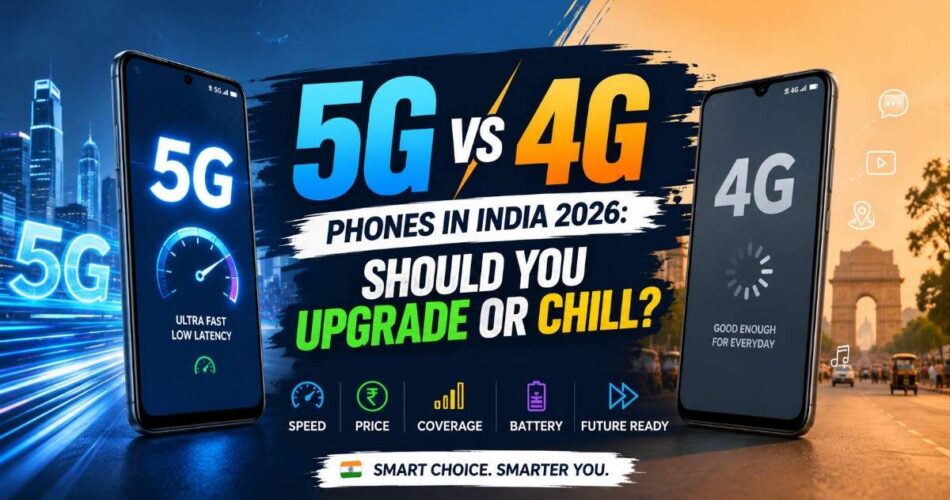
You open Flipkart or Amazon, search “phone under 20,000,” and suddenly the whole grid looks like a 5G sales pitch. “Future‑ready 5G.” “Next‑gen 5G.” “5G revolution.” Your existing 4G phone is quietly doing its job, slightly offended.
Here’s the annoying part: everyone keeps saying “5G is the future,” but your actual question is more basic do I really need this thing right now, or is this just FOMO with better branding? India already has hundreds of millions of 5G users, operators shout about “nationwide 5G,” and yet your signal still drops in the lift.
This guide is the honest version. No tech worship. No “5G will change humanity” speech. Just: what 5G really changes for a normal Indian phone user in 2026, where it actually works, and when upgrading from 4G makes sense and when it’s just a polite way to burn money.
The thing nobody actually says out loud
Let’s start with the part most glossy “5G explainer” posts politely skip: for many people in India, 5G in 2026 is… nice, not life‑changing. Most people just want WhatsApp to send, YouTube to not buffer, UPI to go through, and BGMI to not lag all of which 4G already does decently when the tower isn’t dying.
Yes, 5G can be several times faster than 4G under good conditions. Opensignal and others show Indian 5G users getting far better video streaming and gaming performance than 4G operators are very proud of that. The problem is, your life is not lived “under good conditions.” It’s lived in crowded markets, trains, hostels with 200 people on the same tower, and inside random concrete boxes called houses.
Here’s the part that makes the whole debate messy: India’s 5G rollout has been insanely fast. By late 2026, we were already looking at around 400 million 5G subscribers and roughly a third of all mobile connections on 5G. Jio and Airtel pushed 5G across every state and UT, and Jio in particular now boasts the widest 4G and 5G coverage footprint in 2026. The marketing is not lying when it says 5G is “everywhere” it’s just… not equally good everywhere.
Think of it like this:
- In big cities and dense areas, 5G often feels obviously faster than 4G, especially for large downloads, gaming, and high‑quality streaming.
- In semi-urban and many rural areas, 5G exists on the map, but actual speeds can swing. In bad coverage pockets, 4G can still be more stable.
The thing nobody says: for a lot of Indian users, the real upgrade you feel first is not “5G vs 4G,” it’s “cheap phone vs decent phone.” A ₹12k 4G phone with weak processor, slow storage and bad modem will feel worse than a solid ₹18k 5G phone even on 4G network, simply because the hardware is better.
There’s also this very human pattern: you buy a 5G phone “for the future,” use it mostly on 4G for a year, and when 5G becomes actually good in your area, you’re already itching to upgrade again. Ask anyone who bought a ‘future‑proof’ 4G phone in 2015.
So the real question isn’t “is 5G better than 4G?” On paper, of course it is: higher speeds, lower latency, more capacity, all the usual slides 5G can be up to 10–100x faster than 4G in ideal tests and get down to single‑digit millisecond latency. The real question is: will your life in your area in 2026 get better enough to justify paying extra or forcing an upgrade? For a growing chunk of people, yes. For many others, 4G is still quietly enough.
How this actually works the real mechanics
Let’s decode what 5G vs 4G actually means when you’re standing on your balcony in Bareilly, Pune, or Chennai trying to upload a Reel.
4G (LTE) was the jump that made YouTube in HD, video calls, and constant Instagram scrolling normal. Typical real-world speeds are in the 10–50 Mbps range for many users, sometimes higher, sometimes much lower. 5G is the newer standard that aims for hundreds of Mbps to around 1 Gbps in realistic conditions, and technically up to multi‑gigabit speeds in ideal setups. Latency that tiny delay you feel when gaming or video calling drops from 20–40 ms on 4G to under 10 ms on a good standalone 5G setup.
India’s story is a little specific:
- By 2025, India had ~365 million 5G users and ~35% penetration, and Ericsson projects around 394 million 5G subscriptions by end‑2025.
- Jio and Airtel now cover the entire country “officially” with 5G, with Jio typically leading in widest coverage, and Airtel focusing on reliability in many circles.
- 5G networks started as “non-standalone” piggybacking on 4G core and are gradually moving to more “standalone” style in some pockets, which improves latency and stability.
But here’s the niche angle generic articles rarely touch: capacity. 5G isn’t just about your download speed test flex. It’s about towers handling a ridiculous number of users at once without collapsing. In crowded areas metro stations, malls, concerts 5G’s extra capacity and better spectrum use help keep speeds sane when 4G would just give up. That is where you actually feel the difference in India’s real chaos.
Also, 5G phones sold in 2026 usually come with:
- Newer chipsets with better efficiency
- Slightly better modems and antenna design
- Often better displays and faster storage at the same price segment
So yes, 5G is a network thing, but modern 5G phones also quietly fix a lot of other pain points.
Some honest observations:
- 5G speed bragging rights
Speedtests touching 300–500 Mbps on Jio/Airtel 5G are common in many cities now, at least when the tower is not overloaded. Will you notice beyond 50–100 Mbps in daily use? Only for big downloads, cloud gaming, or heavy work. - 4G still winning in some patches
In weak 5G coverage areas, a solid 4G connection can give better, more stable experience than a flaky 5G signal that keeps switching. If your area is half‑hearted 5G, your phone will keep jumping between 4G and 5G and that can hit battery and consistency. - Battery life myth
Early 5G phones did drain more. By 2026, modems and networks got better; in many mid‑range phones, the battery difference between 4G‑only and 5G‑on is smaller than TikTok/Instagram usage difference. Heavy 5G downloads still eat battery quickly though. - Roaming and coverage mix
Travel a lot by train or across states? You will hop between strong 5G, weak 5G, and solid 4G all day. The phone’s modem quality matters more than marketing here.
So yes, 5G is “better tech.” The question is whether that better tech is actually arriving at your SIM card, in your location, for the way you use your phone.
Also Read: Best 5G Phone Under ₹15000 In India (2026): The List Your Cousin Will Ask For Later
COMPARISON WHAT’S ACTUALLY DIFFERENT BETWEEN YOUR OPTIONS
| Option | What it actually does | Who it’s for | The catch |
| Stay on current 4G phone | Keeps life exactly as it is; WhatsApp, UPI, YouTube, reels keep working | Light-medium users, stable 4G area, tight budget | No 5G access, phone may feel slow for other reasons in 1–2 years |
| Buy budget 5G phone (₹12–18k) | Gives you 5G access where available, modest speed jump, newer hardware | Students, value hunters, early 5G areas | Often compromises on camera/display; 5G bands may be limited |
| Buy mid‑range 5G (₹18–30k) | Strong everyday performance, much better 5G experience, more bands | Gamers, heavy streamers, people keeping phone 3+ yrs | Higher upfront cost; Overkill if area stuck on patchy 5G |
| Premium 5G (₹30k+) | Best chips, bands, cameras; 5G works well almost everywhere 5G exists | Power users, creators, long-term buyers | Diminishing returns if your usage is basic and area 4G‑heavy |
If you are upgrading anyway in 2026 and can afford it, my actual take: go for a decent mid‑range 5G phone instead of a late 4G model especially if you’re in a city or big town with stable 5G already. If your budget is tight, your area is 4G‑only or very patchy, and your current phone isn’t dying, forcing a 5G upgrade just for the logo is pointless flex.
Must READ: Best Phone Under ₹20000 in India 2026: The Budget “Flagships” No One Warned You About
WHAT ACTUALLY HAPPENS WHEN YOU TRY THIS
When you actually switch from a 4G phone to a 5G phone in a city that has a decent rollout, the first dramatic moment is usually a speed test. The meter jumps to numbers you’ve never seen before, you feel like you now own a small satellite, and then… you go back to scrolling Instagram the same way as yesterday.
What changes in real life: big downloads become casual. A 2–3 GB game, which earlier you’d start and go make chai, now finishes while you’re still on the same chair. Updating big apps, downloading Netflix shows for a trip, or installing system updates becomes less of a “plan it on Wi‑Fi” thing and more “I’ll quickly do it on mobile data.” For many people, this subtle shift is the actual quality‑of‑life upgrade.
In multiplayer gaming, good 5G cuts down those micro lags and rubber‑banding moments if the server is decent and the tower is not overloaded. You still lose matches because someone else is better, not because “ping bad.” Video calls feel a bit more stable at higher resolution, although this is as much about operator backhaul and congestion as raw 5G vs 4G.
One thing that surprises many people: sometimes, 5G performs worse than 4G in patchy zones. Your phone keeps on switching bands, the signal bars dance around, and speed tests show erratic numbers. Telecom engineers and field tests have pointed out that in weak coverage areas, LTE can actually feel more reliable than half‑baked 5G. This is why operators themselves quietly recommend using 4G in some conditions, even while they market 5G everywhere.
Another pattern most articles miss: the upgrade math over time. By late 2025, a huge share of new phones shipped in many markets globally had already become 5G‑ready; in some regions, 70%+ of new smartphones sold were 5G as early as 2022–2023. India is catching that wave fast. This means app and game makers are slowly designing with 5G‑class speeds and latency in mind. If you hold a 4G phone till 2028, nothing will “stop working,” but you may see newer heavy apps feeling sluggish on older hardware more than on the network itself.
The boring but honest experience:
- Week 1: You run many speed tests, tell friends “bro 400 Mbps,” switch between 5G and Wi‑Fi just because.
- Week 3: You forget it’s 5G and only notice when you download something big or travel to a pure‑4G area.
- Month 6: The value comes from the fact you bought a newer, better overall phone, not just the network label.
What nobody warns you about here is that if you buy a poor‑quality budget 5G phone, you can end up with the worst combo: a 5G logo on the box but weak real‑world speeds, limited bands, poor cameras, and mid battery. The “5G” part doesn’t fix a bad phone.
THE ADVICE EVERYONE GIVES VS WHAT ACTUALLY WORKS
Common advice 1: “Always buy 5G now, 4G is dead.”
4G is not dead. 4G is the backbone of Indian mobile data in 2026. Even with 365+ million 5G users and fast growth, a majority of mobile subscriptions are still on 4G, and operators will keep 4G running for many years simply because they cannot shove a billion people to 5G overnight. Saying “4G is dead” sounds dramatic; it’s just wrong.
What works: if you’re buying in 2026 and plan to keep the phone for 3–4 years, 5G is sensible if it fits your budget and your area has or will soon have good 5G. If you’re replacing a broken phone on a tight budget and live in a mostly 4G town, a solid 4G phone with better camera and storage may give you more day-to-day happiness than a compromised 5G model.
Common advice 2: “Wait until 5G is everywhere, then upgrade.”
Cool, but we passed the “wait” stage. By early 2026, India’s 5G coverage is already across all states and UTs, with hundreds of millions of active users. This isn’t some future pilot anymore. The real issue isn’t “is 5G available in India,” it’s “how good is 5G in your area, and how much time you spend in good zones.”
What works: don’t wait for a mythical “perfect nationwide 5G.” Check actual coverage and user experience for your operator in your locality (speedtests, friend’s phone, coverage maps, reviews). If it’s decent and you’re due for an upgrade, go 5G. If your town’s reality is still poor even on 4G, network choice and operator may matter more than 5G vs 4G.
Common advice 3: “5G is only for heavy gamers and tech nerds.”
Mostly said by people whose usage is literally only WhatsApp and calls. Yes, gamers and heavy streamers benefit first from low latency and faster speeds. But 5G also helps if you regularly download large files for work or study, upload videos, rely on hotspot for laptop, or travel through congested places where 4G chokes.
What works: think about your worst network moments in the last year failed video calls, choppy online classes, downloads stuck at 90% before a deadline. If those moments are frequent and you now live in or move to a city with solid 5G, it’s not “nerd behavior” to want smoother connectivity. It’s just self-respect.
Common advice 4: “Premium 5G only, budget 5G is useless.”
Convenient advice if you sell premium phones. Budget and mid‑range 5G has improved a lot many sub‑₹20k phones now offer enough bands and decent modems for everyday 5G use, especially on Jio and Airtel’s current deployments. Not flagship‑level, but not “useless” either.
What works: pick based on your priorities. If you care about camera and display more than bragging‑rights speeds, you might actually be happier with a slightly older upper‑midrange 5G phone or a balanced mid‑ranger than a cheap model that cut too many corners for the 5G label.
THE PRACTICAL PART WHAT TO ACTUALLY DO
1. Check 5G coverage and user reality where you live and work
Don’t trust just one operator ad. Use friends’ phones, YouTube reviewers in your city, and independent reports like Opensignal’s “India Mobile Network Experience” that show 5G performance by operator and circle. If Jio 5G is strong in your area but Airtel 5G is patchy (or the reverse), that alone can change your upgrade plan.
2. Decide your phone lifespan honestly
If you usually keep a phone 2–3 years or more, shifting to 5G in 2026 is logical, because by 2028–29, 5G penetration will be far higher and 4G networks will slowly be de-prioritised in many dense areas. If you upgrade every 12–18 months anyway, you don’t need to panic-buy 5G “for the future” right this second your next upgrade will almost certainly be 5G.
3. Fix budget, then pick the best balance not just “5G label”
Within your price range, compare at least 3 phones: chipset, RAM/storage, 5G bands, camera, battery. Newer 5G-capable SoCs generally give better general performance and efficiency, which matters as much as network speed. Don’t sacrifice everything (camera, screen, storage) just to say “my phone is 5G” on a model that barely holds network.
4. Match operator + phone combo smartly
If you’re on Jio, check how many of its primary 5G bands your shortlisted phone supports. Same for Airtel. Some budget 5G phones cover only a couple of bands; mid‑range and premium ones cover more, which gives better performance as networks evolve. A 5G phone that doesn’t support your operator’s main bands is like buying a sports bike and never leaving first gear.
5. Think about your worst-case usage, not average day
Average days are easy both 4G and 5G handle that. Think about exam season online classes, live sports streaming, uploading a big client video, traveling during Diwali, or daily use in a super‑dense area. If those moments matter and 5G is strong where you are, the upgrade is easier to justify.
6. If you keep 4G, pick a genuinely good 4G phone
Don’t punish yourself with some random low-end thing “just because 5G isn’t needed.” A capable 4G phone with strong SoC, enough RAM, and decent modem will stay usable longer and make apps feel faster even on the same network. You’re choosing not to upgrade network yet, not choosing suffering as a lifestyle.
7. Don’t forget the actual cost: data
5G makes it very easy to burn through data packs without realizing. If you switch, also check your operator’s 5G fair‑usage terms, hot‑spot speeds, and tariff changes since mid‑2024. Higher speed without data discipline is just a faster way to hit daily limit.
QUESTIONS PEOPLE ACTUALLY ASK
Should I upgrade from 4G to 5G phone in India 2026?
If your current 4G phone works fine and you live in an area with weak or no 5G, there is no urgent need. 4G will continue in India for years, and basic tasks run fine on it. If you live in a city or big town where Jio or Airtel 5G is stable, and you are due for an upgrade anyway, shifting to a good 5G phone makes sense because you’ll benefit now and be future‑friendly for 2–3 years. The key is: upgrade when you need a better phone, not because an ad scared you.
Is 5G phone worth it in India right now?
For many users in 2026, yes especially gamers, streamers, frequent travelers in urban areas, and people who keep phones long-term. Real‑world tests show 5G in India offering much better video streaming, gaming, and download speeds compared to existing 4G. If your usage is light and your budget is tight, a stable 4G phone can still be “worth it” your satisfaction comes from the device quality more than the network logo.
Does 5G work everywhere in India or only in cities?
Operators now claim 5G presence in every state and union territory, and the 5G user base has already crossed hundreds of millions. But coverage quality is uneven. Metro cities and big towns get the best 5G experience; tier‑2 cities follow closely. Smaller towns and rural areas may have patchy or limited 5G, where 4G still does the heavy lifting. Always test in your actual locality before relying on the coverage map alone.
Will my 4G phone stop working in India soon?
No. 4G is not going away anytime soon. Even Ericsson’s long‑term projections for India talk about 5G crossing 1 billion subscriptions around 2031, not tomorrow. That still leaves a large 4G base in the system. Operators will slowly shift spectrum and investments towards 5G as penetration grows, but for the next several years, 4G phones will continue to work for basic use. Over time, new network improvements and offers may be more focused on 5G users.
Is 4G phone enough for normal use in India?
For calls, WhatsApp, UPI, social media, music, and even a lot of HD streaming, a good 4G connection is enough. 4G speeds in many areas can handle 1080p video, video calls, and light gaming without trouble. The issue is not “4G vs 5G” but whether your particular 4G tower is overloaded or your phone is underpowered. If your 4G works fine now, you’re not “behind.” If your 4G experience is consistently bad while others nearby enjoy better 5G, that’s when “enough” stops being enough.
Which is better for gaming in India, 4G or 5G?
For online gaming, lower latency and consistent speed matter more than peak Mbps. 5G, especially on mature deployments, offers lower latency and better experience for cloud and competitive gaming when coverage is strong. Reports show India’s 5G users enjoying superior gaming experience over 4G. But if your 5G signal is weak or unstable, a solid 4G connection can still feel better than a flaky 5G one. If gaming is your main thing and your city has good 5G, a mid‑range 5G phone is a very reasonable expense.
Will 5G use more battery than 4G?
Early 5G phones did have noticeable battery drain on 5G. Newer 5G chipsets and better network tuning have improved this; in many mid‑range phones, battery life difference between 4G and 5G is smaller than the difference between light vs heavy use generally. That said, constant high‑speed downloading or hotspotting on 5G will drain faster you’re pushing more data in less time. Most phones let you lock network to 4G when you want to save battery.
Do I need a new SIM for 5G in India?
Most users on major operators like Jio and Airtel can use 5G on existing 4G SIMs, as long as the SIM is relatively recent and the number is under an eligible plan. The key requirements are: a 5G-capable phone, 5G coverage in your area, and a plan that supports 5G access. Check with your operator app; they usually show 5G readiness status.
SO WHERE DOES THIS LEAVE YOU?
Here’s the honest state of things: 5G in India 2026 is real, fast, and already used by hundreds of millions of people especially in cities. 4G is still the quiet backbone that keeps most people online, and it’s not going to vanish just because someone shouted “future is 5G” in a launch event.
If you’re buying your next phone this year and can stretch a bit, picking a good 5G phone is usually the smart bet provided your area has or will soon have solid 5G, and you don’t sacrifice everything else just for that logo. If your budget is tight, your 4G works fine, and you don’t do heavy gaming or downloads, you’re not “doing life wrong” by staying on 4G for another cycle.
The one concrete thing you can do today: check real 5G coverage and user experience for your operator in your area not ads, actual speedtests and friends’ phones. Once you know your local reality, the 4G vs 5G decision stops being abstract tech talk and turns into a simple money vs benefit trade‑off. It won’t be perfect, it won’t be permanent, but it will be yours .
You made it till here without your brain switching to airplane mode, which already puts you above average. So here’s the line that actually matters: don’t upgrade to 5G because someone told you 4G is “over,” upgrade because your current phone and network genuinely annoys you more than the price of a better one.
If that’s true, a solid 5G phone in 2026 is a good move. If not, close the tab, charge your 4G phone, and spend that money on something that actually makes your day better. Maybe even on actual food instead of virtual speed.