Welcome to my blog post comparing the Honda Shine Electric vs Petrol.
The Honda Shine has been a trusted companion for Indian commuters for years, known for its reliability and fuel efficiency. Now, with Honda entering the electric two-wheeler space, buyers face a new dilemma: stick with the proven petrol variant or make the leap to electric? This isn’t just about choosing a bike—it’s about choosing a lifestyle, and we’re here to help you make that decision.
The Numbers Game: What You’re Getting
Before we dive deep, let’s look at what separates these two variants. The petrol Honda Shine delivers around 55-60 kmpl, powered by a 124cc engine producing about 10.7 bhp. The electric version, meanwhile, promises zero tailpipe emissions with instant torque delivery and an estimated range of 80-100 km on a single charge, depending on riding conditions.
The price difference is significant. While the petrol Shine starts around ₹75,000-80,000 (ex-showroom), the electric variant commands a premium, typically ranging between ₹1.2-1.5 lakhs. However, this is where the story gets interesting—and complicated.
Performance: Two Different Philosophies
Twist the throttle on the electric Shine, and you’ll immediately notice the difference. Electric motors deliver power instantly—no waiting for RPMs to build, no gear changes, just smooth, linear acceleration. This makes city riding incredibly effortless, especially in stop-and-go traffic where the electric variant truly shines.
The petrol version offers a more traditional experience. Power builds progressively, and while it may not have that instant punch, it delivers a familiar riding feel that many find reassuring. On highways, the petrol engine maintains higher speeds more comfortably over extended periods, while the electric version is primarily designed for urban environments.
Noise is another crucial factor. The electric Shine is whisper-quiet, reducing rider fatigue and contributing to lower noise pollution. The petrol variant, while not loud, produces the characteristic engine hum that some riders actually prefer—it’s a matter of personal preference.
The Real Cost of Ownership
Here’s where electric vehicles start making serious financial sense. Let’s break down a typical five-year ownership scenario.
Running Costs: Charging the honda electric Shine costs approximately ₹15-20 for a full charge at home electricity rates, giving you 80-100 km range. That’s roughly ₹0.20-0.25 per kilometer. The petrol variant, at current fuel prices (around ₹100/liter) and delivering 55 kmpl, costs about ₹1.80 per kilometer. For someone riding 40 km daily, that’s an annual savings of around ₹22,000-24,000 with the electric version.
Maintenance: Electric bikes are mechanically simpler. No engine oil changes, no air filter replacements, no spark plugs, and no clutch adjustments. Annual maintenance might cost ₹2,000-3,000. The petrol Shine requires regular servicing every 3-6 months, with annual maintenance costs hovering around ₹5,000-7,000.
Over five years, considering maintenance and fuel costs alone, the electric version could save you ₹1.2-1.5 lakhs—effectively recovering its higher initial cost. However, this calculation assumes battery health remains optimal, which brings us to an important consideration: battery replacement costs down the line could be ₹30,000-50,000 after 5-7 years.
Range Reality Check
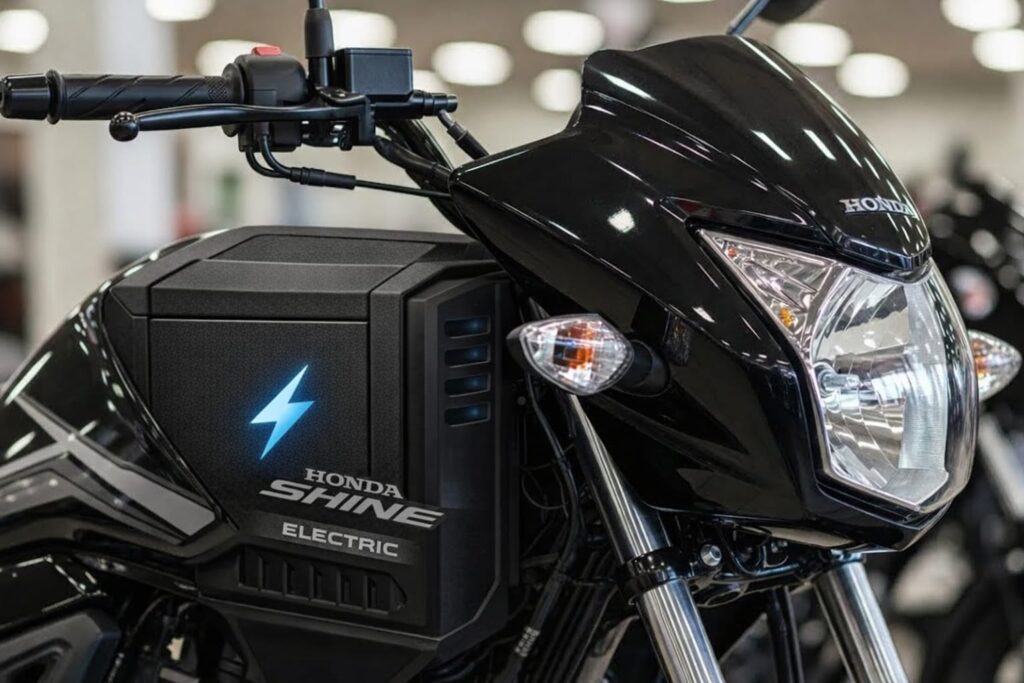
The elephant in the room: range anxiety. The electric Shine’s 80-100 km range is more than adequate for most daily commuters. If your daily round trip is under 60 km, you’ll comfortably charge once every 1-2 days at home.
However, spontaneous long rides become challenging. A weekend trip to a nearby city 150 km away requires planning—finding charging stations, spending 3-4 hours for a full charge, or settling for partial charges. The petrol variant eliminates this concern entirely. Fill up in three minutes at any of India’s countless petrol pumps, and you’re ready for another 300+ km.
Home charging is convenient but requires a dedicated 15-amp power socket and ideally, a parking space where you can plug in overnight. If you live in an apartment without designated parking or lack reliable electricity supply, the electric option becomes less practical.
Infrastructure: The Ground Reality
India’s EV charging infrastructure is growing but remains patchy. Metro cities have decent coverage, but smaller towns lag significantly. Honda may provide a portable charger, allowing you to charge from any standard socket, but this takes considerably longer than dedicated fast charging.
Conversely, petrol pumps are everywhere. This ubiquity offers unmatched convenience and peace of mind, especially if you ride beyond city limits regularly.
Also Read: Royal Enfield Flying Flea C6: 5 Game-Changing Features
Who Should Choose What?
Choose the Electric Shine if:
- Your daily commute is under 50 km with predictable routes
- You have home charging facilities with stable electricity
- 90% of your riding is within city limits
- You prefer riding without producing exhaust fumes
- You can think long-term and appreciate cumulative savings
- You value silent, smooth riding in urban traffic
Choose the Petrol Shine if:
- You frequently take spontaneous long rides
- Charging infrastructure is limited in your area
- You lack reliable home charging options
- You need one bike that does everything without planning
- You prefer the familiarity and widespread service network of conventional bikes
- Immediate resale value matters to you (petrol bikes currently have better resale markets)
The Verdict
There’s no universal answer here—it depends entirely on your lifestyle. The electric Honda Shine is perfect for the urban commuter with a fixed routine and charging access. It offers lower running costs, minimal maintenance, and a guilt-free conscience. The financial math works beautifully if you plan to keep the bike for 5+ years.
The petrol Shine remains the versatile workhorse—ready for anything, anywhere, anytime. It’s the safer bet if you value flexibility, live in areas with limited charging infrastructure, or simply aren’t ready to adapt your routine around charging schedules.
Consider your daily riding pattern honestly. If 95% of your journeys are predictable city commutes, electric makes tremendous sense. If you value spontaneity and range flexibility, petrol remains king. Test ride both variants, calculate your actual daily mileage, and assess your charging situation before deciding.
The future is undoubtedly electric, but the question isn’t whether to go electric—it’s whether now is the right time for you. Both versions of the Honda Shine Electric or Petrol are excellent bikes; choose the one that fits your life, not the one that sounds more appealing in theory.